
Choosing the right granite air bearings supplier can determine whether a precision system performs smoothly or struggles with repeatability. Global buyers often compare quoted accuracy, load capacity, porous material quality, and delivery promises. Yet brochures rarely reveal how a bearing behaves after months of continuous operation.
This guide examines leading granite air bearings suppliers through a practical purchasing lens. It considers manufacturing experience, engineering support, inspection methods, customization capability, and international communication. Buyers should review surface flatness reports, airflow data, pressure requirements, and documented testing procedures before placing an order. Small details matter. A scratched granite surface, inconsistent porosity, or poorly matched restrictor can affect motion quality.
Reliable suppliers usually explain their tolerances clearly. They also provide drawings, application guidance, and traceable quality records. However, no supplier is perfect for every project. A company with excellent metrology experience may offer limited export support. Another may provide fast customization but lack long-term field references. This is where careful comparison becomes essential.
Real-world performance depends on more than product specifications. Installation conditions, air cleanliness, vibration control, and maintenance practices also influence service life. Buyers should ask how suppliers handle technical changes, damaged shipments, replacement parts, and after-sales questions. Those conversations often reveal more than polished marketing language.
Some recommendations may require further verification. Supplier capabilities can change, and public information may remain incomplete. Treat this overview as a qualified starting point, not a final purchasing decision. The strongest choice combines proven expertise, transparent evidence, responsive support, and a realistic understanding of project risks.
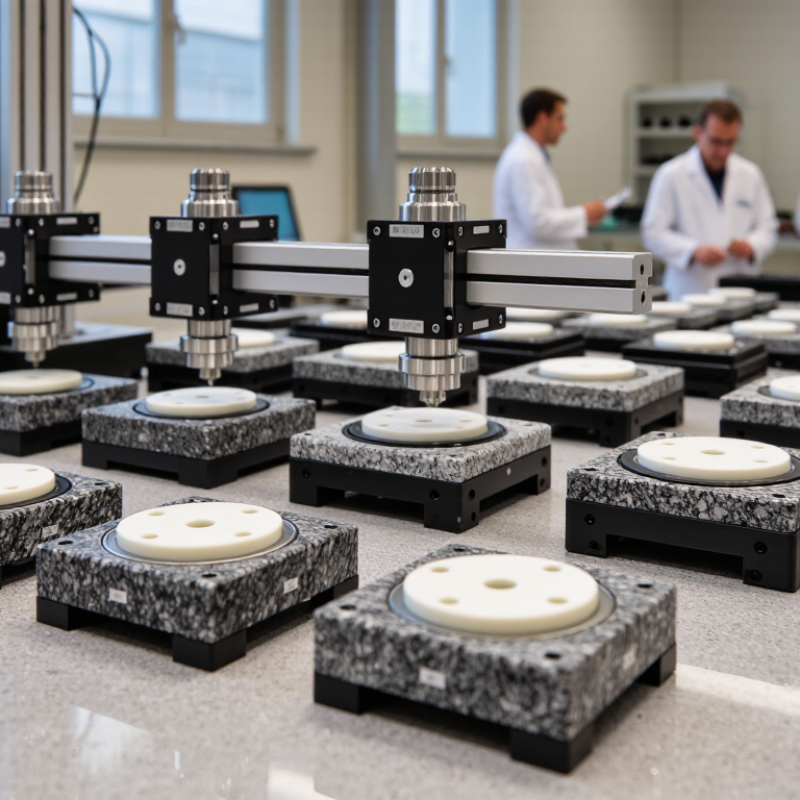
Granite air bearings support precise motion by separating two flat surfaces with a thin air film.
Typical air gaps measure between 5 and 20 micrometres. At this scale, the carriage appears to float above the granite guide.
Small gap. Serious control.
The air film removes most solid contact, reducing friction, wear, and particle generation. It also helps maintain smooth movement during measurement, inspection, and semiconductor equipment operation.
In practical testing, alignment matters as much as the bearing itself. A granite surface with poor flatness can disturb the air gap and create unwanted motion.
Clean, dry air is essential. Pressure stability matters too.
Global buyers should ask suppliers for gap tolerance, load capacity, flatness data, airflow requirements, and installation procedures. They should also confirm inspection methods and after-sales technical support.
A capable supplier can explain how the bearing performs under changing loads, temperatures, and travel speeds. Specifications may look perfect on paper, but installation errors still cause problems.
That is an uncomfortable lesson.
Preloading, mounting torque, and surface cleanliness deserve careful checks. Buyers should request test records from comparable applications, not only general performance claims.
Proper maintenance remains simple, but ignoring it can slowly reduce precision.
When comparing granite air bearing suppliers, load capacity should match the real moving mass. Include fixtures, cables, and payloads, not only the stage weight. A bearing rated at 500 N may perform poorly near its limit. Leave practical safety margin.
Stiffness controls how much the bearing deflects during measurement or machining. Look for vertical and lateral stiffness values, preferably with test conditions stated. Accuracy depends on more than the bearing itself. Granite flatness, guide geometry, temperature stability, and installation quality all matter. Ask for flatness data across the usable surface, not just a best-point result. A few microns can affect a long travel path.
Air flow is equally important for operating cost and stability. Confirm pressure, consumption, filtration requirements, and flow uniformity. Dirty or wet air can damage performance quickly. I have seen systems meet laboratory specifications but fail after poor site preparation. That detail is often missed. Request inspection records, calibration methods, and repeatability results from representative units. Supplier support also matters when the granite base needs leveling or the air gap changes. Some published figures look impressive, yet their test setup remains unclear. That deserves questions. A careful buyer should compare measured performance, service response, and documentation before choosing a supplier.
Global buyers often compare granite air bearing suppliers by more than price. The strongest supplier profiles show technical depth, stable inspection, and responsive engineering support. Porous-media suppliers build bearings with fine, distributed airflow through granite. This design can provide smooth motion and strong damping in precision stages. Ask for pore uniformity data, flatness reports, and test results under load. A polished brochure is not enough.
Aerostatic specialists use controlled air films between matched surfaces. Their systems suit coordinate machines, optical platforms, and semiconductor inspection tools. Reliable suppliers explain stiffness, flow demand, gap control, and cleanliness requirements. They should also state how performance changes with temperature and supply pressure. In practice, installation quality matters as much as bearing geometry. Small piping errors can create uneven motion.
Custom suppliers are valuable when standard sizes cannot meet travel, payload, or mounting limits. Look for teams that review drawings, tolerance chains, materials, and commissioning plans. Integrated-system suppliers may combine granite structures, air preparation, guides, sensors, and control interfaces. Their advantage is fewer handoffs during integration. Still, buyers should demand clear ownership for service and replacement parts. I would not accept vague promises about lifetime or accuracy. Some specifications remain difficult to compare across suppliers. Independent acceptance testing can expose those gaps before shipment. No profile is perfect.
When evaluating granite air bearing suppliers, ISO 230-2 testing should be more than a certificate on paper. The standard measures positioning accuracy and repeatability in numerically controlled systems. It does not define one universal tolerance for every granite bearing application. Buyers should request test conditions, axis travel, thermal state, measurement uncertainty, and raw interferometer data.
Tolerance claims need practical context. Ask for granite flatness, parallelism, surface roughness, pore-free finishing, and air-film stability. A qualified supplier should link these values to the intended load, pressure, speed, and environmental temperature. ISO 17025 accreditation strengthens confidence in calibration results, while ISO 9001 supports process control. Still, certification alone proves little. The test method matters.
Demand material certificates, calibration traceability, inspection dates, and acceptance criteria before ordering. The International Federation of Robotics reported 541,302 industrial robot installations in 2022, showing continued demand for precise motion systems. That growth makes repeatable supplier data increasingly important. I would also compare performance at operating temperature, not only in a controlled laboratory. Small thermal shifts can change alignment. This is often overlooked.
A useful audit includes witness testing, dimensional sampling, and corrective-action records. Suppliers should explain failed inspections openly. Perfect records may look suspicious. Real manufacturing has variation. The critical issue is whether variation is measured, controlled, and reported honestly.
Global buyers evaluating granite air bearing suppliers should verify lead times before comparing prices. Standard plates may ship within weeks, while custom drilling, lapping, or integrated air channels can require several months. Ask for a written production schedule, inspection points, and packaging method. A wooden crate protects the surface, but poor shock control can still cause hidden damage.
Installation needs practical planning. Confirm the required floor strength, leveling method, air pressure, filtration, and clean-room conditions. Experienced suppliers should provide drawings, tolerances, commissioning guidance, and technician support across regions. Maintenance is usually simple, but contaminated air can damage performance quickly. Keep filters, seals, and pressure regulators available locally. Do not assume every technician understands air bearing behavior.
Tips: Request a landed-cost quotation, including crating, freight, insurance, duties, installation, spare parts, and training. Compare the first-year cost, not only the purchase price. Ask how rejected components are handled and whether calibration records accompany delivery. A low-cost quotation may exclude alignment work or emergency support. That detail matters. Buyers should also test response times before signing; slow communication during sales often becomes slower after installation. My own caution is simple: supplier questionnaires look convincing, yet real references may reveal delays that polished documents hide.("")]
