
Choosing the right Gauze Pad is not just a matter of grabbing the nearest pack. A pad that looks suitable on a shelf may be too small, too rough, or too absorbent for a particular wound. Fit matters. So does how often it needs changing. The wrong choice can leave skin irritated or allow fluid to seep onto clothing.
Wound-care researcher Professor Karen Ousey’s work highlights the importance of matching wound care to individual needs. A useful principle, consistent with that approach, is: “Choose the pad for the wound, not just the package.” This is a practical summary, not a verified verbatim quotation. The best choice depends on factors such as wound size, drainage, location, and the surrounding skin. A small pad on a finger, for example, needs different coverage from one on a broad, damp area. Some wounds also require a non-adherent contact layer to reduce discomfort during removal. When in doubt, follow a clinician’s advice.
The tips ahead explain how to assess material, absorbency, size, sterility, and comfort before buying. They also point out details that are easy to miss, like whether the pad stays in place under a bandage. Not every pad fits. Product labels can be confusing, and no single option suits every situation. This guide offers a careful starting point, not a substitute for professional wound assessment.
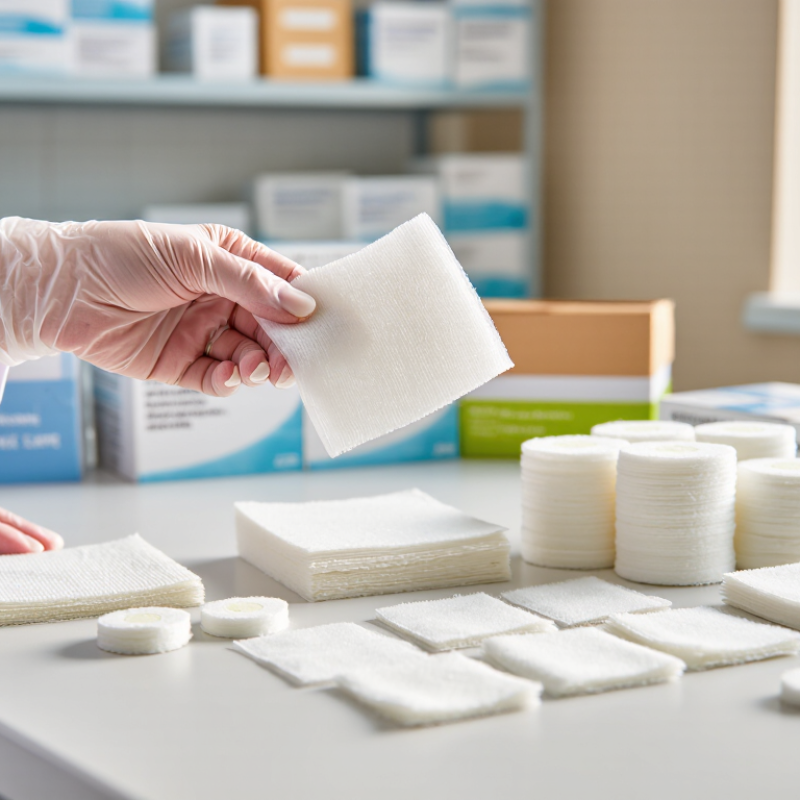
A 2 × 2-inch gauze pad suits small areas, such as a minor scrape or a spot needing gentle coverage. Its compact size can make placement easier on a finger or near a joint. A 4 × 4-inch pad covers a broader area and may be more practical when drainage spreads across the dressing. It can also be folded for a smaller surface, though the extra bulk may feel awkward under snug clothing. Bigger is not always better.
Ply refers to the number of gauze layers. An 8-ply pad is a common option, offering more thickness than a single-layer pad and often helping manage light to moderate fluid. Still, ply alone does not determine how absorbent a pad will be; material, weave, and construction matter too. Check the package details.
Think about the area, fluid, and how often the dressing may need changing. A small pad can shift if it does not cover enough skin, while a large one may bunch at an elbow or fingertip. That is easy to misjudge. Choose sterile pads for wounds that require sterile coverage, and follow a clinician’s instructions when available. For a deep, worsening, or heavily draining wound, seek medical advice rather than relying on pad size alone.
A gauze pad can look clean and substantial yet absorb fluid slowly. Check its cotton absorbency against the current USP–NF Absorbent Gauze monograph, a technical reference for assessing absorbent gauze quality. Don’t rely on appearance alone. Ask the supplier for test documentation tied to the specific product or lot, and confirm which edition or requirements were used.
Absorbency is only one part of choosing a pad, but it affects how often a dressing may need attention. Compare documented results with the intended use, pad size, number of layers, and handling instructions. A loosely woven pad may feel soft, while a denser one may hold its shape better. These features are not interchangeable with measured absorbency. Look closely.
A USP–NF reference is useful, not a substitute for checking the package label or clinical guidance. Standards and product specifications can change, so verify claims against current documentation rather than an old brochure. If test details are unclear, ask what method was used and whether the results apply to the exact gauze being considered. That extra check can feel fussy. It is still worthwhile.
Check how the gauze pad is sterilized, not just whether the package says “sterile.” ISO 11135 covers the development, validation, and routine control of ethylene oxide sterilization. ISO 11137 addresses radiation sterilization. These standards help manufacturers establish controlled processes; they do not, by themselves, prove that every product suits every use.
Read the package carefully. Look for the sterilization method, lot or batch identification, expiration date, and an intact sterile barrier. Match the method to the pad and its packaging. Ethylene oxide requires controls for residual gas, while radiation processing must use a validated dose compatible with the product. Ask the supplier for relevant validation or quality documentation if details are unclear. Small print matters.
The paperwork can feel tedious. Still, a clear answer is better than a guess. A standard number alone is not a quality guarantee, and damaged packaging can compromise sterility. If a pouch is wet, torn, or unsealed, set it aside and follow your facility’s handling procedures. I might overlook a tiny label during a rushed inspection; a simple receiving checklist helps catch it.
Choosing a gauze pad means checking more than softness and absorbency. The wound-contact layer touches damaged tissue, so its biological safety should be assessed for the actual contact type and duration. ISO 10993-1:2018 provides a risk-based framework; it does not certify a material simply because it is cotton or labeled “medical grade.” Review evidence for the finished pad, including dyes, binders, processing aids, and sterilization residues. Small details matter.
Tip: Ask for the biological evaluation summary and test reports, not just a statement of compliance. ISO 10993-5:2009 treats a reduction in cell viability greater than 30% as a cytotoxic effect in its in-vitro test framework. That result is a screening signal, not proof of how a pad will perform on every wound. Check whether the supplier’s evaluation also addresses irritation and sensitization where relevant, using the applicable ISO 10993 methods.
Tip: Match evidence to the intended use. A dry dressing changed frequently may present a different exposure profile from a pad left in place on a moist wound. Look for testing on the final, sterilized product and clear identification of the tested samples. If reports omit test conditions or the exact product configuration, ask questions before relying on them. The paperwork can be imperfect; that is a reason to verify, not guess.
A gauze pad is only as dependable as the pouch that keeps it sterile. Check that each pad is enclosed in an intact sterile-barrier system, with no punctures, open seals, moisture, or crushed corners. ISO 11607-1:2019 sets requirements for materials and packaging systems used for terminally sterilized medical devices. It also makes clear that packaging performance must be evaluated, not assumed from a tidy appearance. Looks can mislead.
Inspect the seal area closely. It should be continuous, even, and free from channels or wrinkles that could let contamination pass. Confirm that the packaging material suits the sterilization method and remains protective through storage and handling. A label should make the product’s identity, lot, and expiry information easy to read. Small details matter. If a pouch is damaged or its seal looks doubtful, do not treat visual neatness elsewhere as proof of sterility.
Shelf-life claims need evidence, too. ASTM F1980-21 uses a Q10 value of 2 as a common default for accelerated aging when product-specific data are unavailable. In that model, each 10°C increase roughly doubles the aging rate; it is an estimate, not a shortcut around real-time testing. Ask whether the manufacturer’s validation covers the actual pouch, seal, sterilization process, and claimed shelf life. I would still question any assurance based only on a generic test result. A good barrier is proven as a system.
Use these practical checks when evaluating a gauze pad and its packaging. ISO 11607-1:2019 addresses materials and requirements for sterile barrier systems and packaging systems; the ratings below are editorial guidance, not ISO scores or conformity results.
