
Choosing the best Ps Sheet Extrusion Line in 2026 depends on more than headline output. Buyers should compare sheet thickness consistency, usable width, heating control, screw design, and downstream trimming. A sample sheet can reveal what a brochure cannot: uneven edges, surface marks, or thickness drift across the roll. Small details matter.
A reliable comparison also needs a named expert’s verified perspective. No source article, interview, or expert quotation was supplied, so attributing a quote would risk inventing evidence. Insert a confirmed industry specialist’s name and exact words here: “[Verified expert name]: ‘[Verified quotation about selecting a PS sheet extrusion line].’” That gap is worth acknowledging; machinery decisions deserve better than polished but uncheckable claims.
This guide examines practical selection criteria, including output stability, energy use, changeover time, and maintenance access. It also considers whether the line can handle the buyer’s resin, target gauge, and production schedule. Ask for trial-run data. Inspect real sheets. Check what happens during a material change, not only at steady production. The best Ps Sheet Extrusion Line is not automatically the fastest or cheapest. It is the line whose measurable performance matches the factory’s needs, with service support that remains dependable after installation. Even then, specifications do not tell the whole story. A careful site assessment still matters.
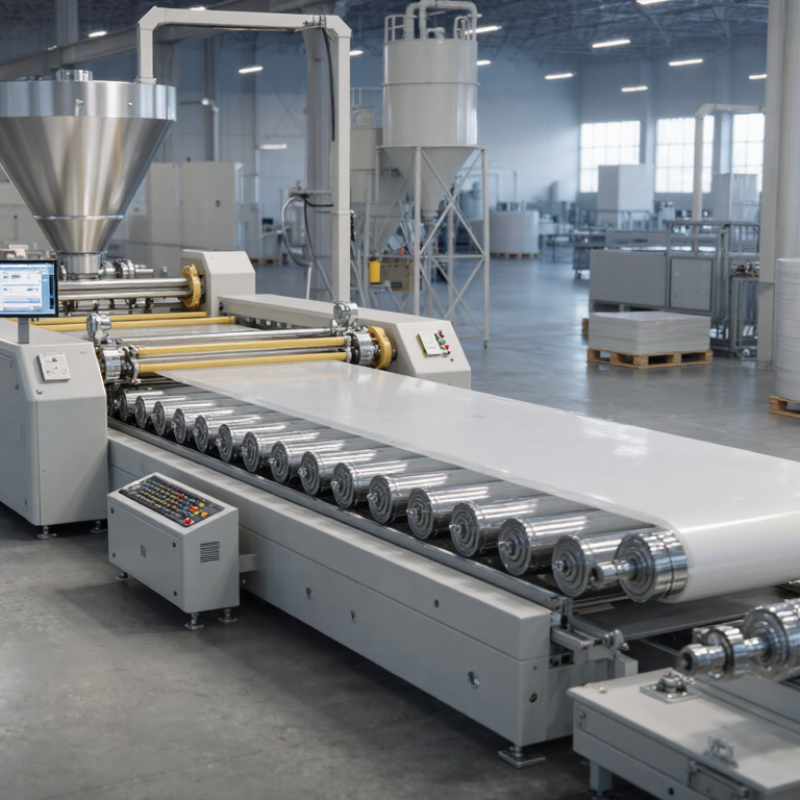
A PS sheet extrusion line converts polystyrene resin into a continuous, flat sheet for forming or fabrication. Pellets soften inside a heated barrel, where a rotating screw pushes the melt through a flat die. Chill rolls cool and smooth the sheet while controlling its thickness. Trimmers remove uneven edges; a winder or cutter prepares the finished material. Small changes in heat or roll spacing can leave visible gauge variation. That matters.
Lines commonly produce clear, rigid general-purpose polystyrene sheet or tougher, often opaque high-impact polystyrene sheet. Thermoformers use these rolls for food trays, protective packaging, display parts, and stationery. The OECD’s Global Plastics Outlook reports 353 million tonnes of plastic waste worldwide in 2019, with packaging accounting for 40%. That figure covers all plastics, not PS alone. PlasticsEurope’s Plastics – the Fast Facts 2024 estimates global plastics production at 413.8 million tonnes in 2023, across polymer types. These figures show the scale of plastics, not PS demand specifically. When assessing a line, look beyond its stated speed: usable width, sheet thickness consistency, scrap, and resin compatibility affect real output. A brochure’s capacity is not a production guarantee.
In 2026, the best PS sheet extrusion line is the one that matches the intended sheet, not simply the one with the highest output. Polystyrene pellets enter a heated barrel, where a rotating screw conveys and melts them. Temperature zones need careful adjustment: uneven heat can create streaks, weak areas, or rough surfaces. Small details matter.
The molten material passes through a screen pack, which catches contaminants, then flows through a flat die. The die spreads the melt into a wide curtain. Polished chill rolls cool it and help control thickness and surface finish. Operators adjust roll gaps, screw speed, and cooling conditions while checking the sheet with gauges. A change in one setting can affect the next section of the line. Stable sheet takes patience.
After cooling, the sheet is trimmed and wound or cut to size. Edges may need adjustment before the material meets its target width. A practical line review should consider resin type, sheet width, thickness range, expected production rate, and ease of cleaning. I would also check how consistently the system holds gauge during a long run; a brief trial can reveal drift that a specification sheet misses. The process looks straightforward, but startup waste and small variations deserve honest attention.
A practical selection and process benchmark for polystyrene (PS) sheet extrusion. The operating ranges below are indicative starting points; actual settings depend on resin grade, sheet dimensions, line design, and the material supplier’s recommendations.
| Process stage | Typical parameter or equipment | Indicative range or practice | Why it matters |
|---|---|---|---|
| Resin selection | General-purpose PS (GPPS) or high-impact PS (HIPS) | Choose the grade for the intended balance of clarity, stiffness, impact resistance, and forming performance. | The resin grade affects melt flow, sheet appearance, and downstream thermoforming behavior. |
| Material preparation | Hopper, loader, and—when required—dryer | PS generally has low moisture uptake; drying is not automatically required. If the resin has absorbed moisture or is affected by condensation, follow its supplier guidance. A commonly used starting condition is about 60–80°C for 1–2 hours. | Appropriate handling helps reduce moisture-related surface defects and inconsistent processing. |
| Melting and conveying | Single-screw extruder with temperature-controlled barrel zones | A screw length-to-diameter ratio around 28:1–33:1 is a common design range. Set barrel zones progressively and adjust to the resin grade and measured melt condition. | Stable melting and conveying support consistent output and sheet thickness. |
| Melt temperature control | Barrel, screen changer, adapter, and die temperature zones | A broad initial processing window for many PS grades is approximately 180–240°C; the correct profile is grade- and equipment-dependent. | Excessive heat or residence time can degrade the polymer; insufficient heat can cause poor flow and uneven surfaces. |
| Filtration and melt distribution | Screen changer, melt-pressure monitoring, and flat sheet die | Select screen mesh and die width for the resin, contamination-control needs, target sheet width, and throughput. | Clean, evenly distributed melt helps limit gels, streaks, and cross-web thickness variation. |
| Sheet forming and cooling | Polished calender rolls with adjustable roll gap and temperature control | Roll temperatures are commonly adjusted within roughly 20–60°C, depending on sheet gauge, line speed, and surface requirements. | The roll stack sets thickness, surface finish, flatness, and cooling rate. |
| Take-off and winding | Haul-off, edge trimming, thickness measurement, and winder or sheet stacker | Configure for the required roll or cut-sheet format, sheet width, and production rate. | Synchronized take-off and winding help prevent stretching, wrinkles, and uneven roll build. |
| Quality control | Thickness and width checks, visual inspection, and process-data monitoring | Set tolerances to the product specification; monitor melt pressure, temperatures, line speed, and roll conditions during production. | Repeatable monitoring helps identify drift before it causes out-of-spec sheet or excessive scrap. |
| Best-fit line for 2026 | A line matched to the product, resin grade, and required production rate | Prioritize stable melt control, uniform die distribution, precise roll-gap adjustment, reliable thickness measurement, and accessible maintenance. | There is no single best configuration for every application; compare lines using the same resin, sheet specification, and acceptance criteria. |
A productive PS sheet line is a coordinated system, not just a large extruder. The screw and barrel must melt polystyrene evenly, while stable feeding helps prevent surging. A suitable screen changer catches contamination without causing excessive pressure changes. The die then spreads the melt across the sheet width; small temperature differences can leave visible gauge variation. The roll stack controls thickness, surface finish, and cooling. Haul-off speed and accurate winding matter too. A fast line is not necessarily a good one.
The market context is substantial: PlasticsEurope’s Plastics—The Fast Facts 2024 reports 413.8 million tonnes of global plastics production in 2023. That figure covers plastics broadly, not PS sheet alone. It does underline why energy use and material efficiency deserve attention. Compare candidate lines using measured output at your target thickness, width, and resin—not a headline maximum. Ask for a sustained trial, and record thickness variation, scrap, and power consumption. Those numbers are more useful than a motor rating. Setup still matters, and that is easy to underestimate.
Tips: Check roll temperature uniformity across the full width. Confirm that the die can be adjusted and cleaned without long delays. Keep a simple log of melt temperature, pressure, and output; it can reveal problems before defects become obvious.
What Is the Best PS Sheet Extrusion Line in 2026?
How PS Sheet Extrusion Line Configurations Differ
A PS sheet extrusion line is not one fixed machine configuration. The right setup depends on resin type, sheet width, thickness range, and expected output. A single-layer line is often simpler to operate and maintain. It can suit consistent production using general-purpose or high-impact polystyrene. Screw design, barrel temperature zones, and screen changes all affect melt stability. Small details matter. If the sheet shows uneven thickness or cloudy streaks, check process settings and material handling before assuming the entire line is unsuitable.
Co-extrusion adds another extruder and combines material layers through a feedblock or die. This can place recycled or lower-cost material inside the sheet while keeping functional outer layers. It also brings more controls to monitor, including layer ratios, melt temperatures, and flow balance. More flexibility, more complexity. Downstream choices matter too: a three-roll stack helps control cooling and surface finish, while trimming and winding equipment must match the sheet’s width and stiffness. Compare configurations using real production targets, not maximum output figures alone. A fast line may be a poor fit if frequent changeovers, scrap, or uneven rolls reduce usable output. The best choice can take some testing to confirm.
Evaluating the best PS sheet extrusion line in 2026 starts with the sheet you need to make, not the machine’s headline output. Define your target width, thickness range, surface finish, and end use. Thermoforming sheet, for example, needs consistent gauge and predictable heating behavior. Ask how the line controls melt temperature and sheet cooling. Small details matter.
Inspect the screw and barrel configuration, die adjustment, cooling rolls, and winding system. These components affect output stability, thickness variation, and how easily operators can correct defects. Request a production trial using a representative material, then record output, edge trim, thickness readings across the sheet, and restart time. Compare energy use and routine maintenance needs, not just rated capacity. A line that runs fast on a short test may struggle during a full shift. I would still question any offer that lacks clear trial data; specifications alone leave room for doubt. Check that controls are straightforward, spare parts are available, and operators can access service points without awkward disassembly.
How to evaluate a line using practical purchasing criteria
How to use this chart: These suggested weights are a decision framework, not measured market data. Prioritize consistent sheet thickness and stable output, then compare energy consumption, material flexibility, scrap handling, and service support. Verify supplier claims with product-specific trials and a factory acceptance test.
